Every successful person faces problems. The difference is not that successful people have fewer problems—it is that they know how to solve them effectively. Whether you’re a student, job seeker, working professional, entrepreneur, or business owner, strong Problem-Solving Skills can help you make better decisions, reduce stress, and achieve faster career growth.
Today, companies don’t just hire people with degrees. They actively look for candidates who can analyze situations, think logically, and solve real-world challenges. That’s why Problem-Solving Skills have become one of the most valuable workplace skills in 2026.
In this comprehensive guide, you’ll learn what problem-solving really means, why employers value it, the different types of problems you may face, and practical techniques that can help you solve problems with confidence in both your professional and personal life.
What Are Problem-Solving Skills?
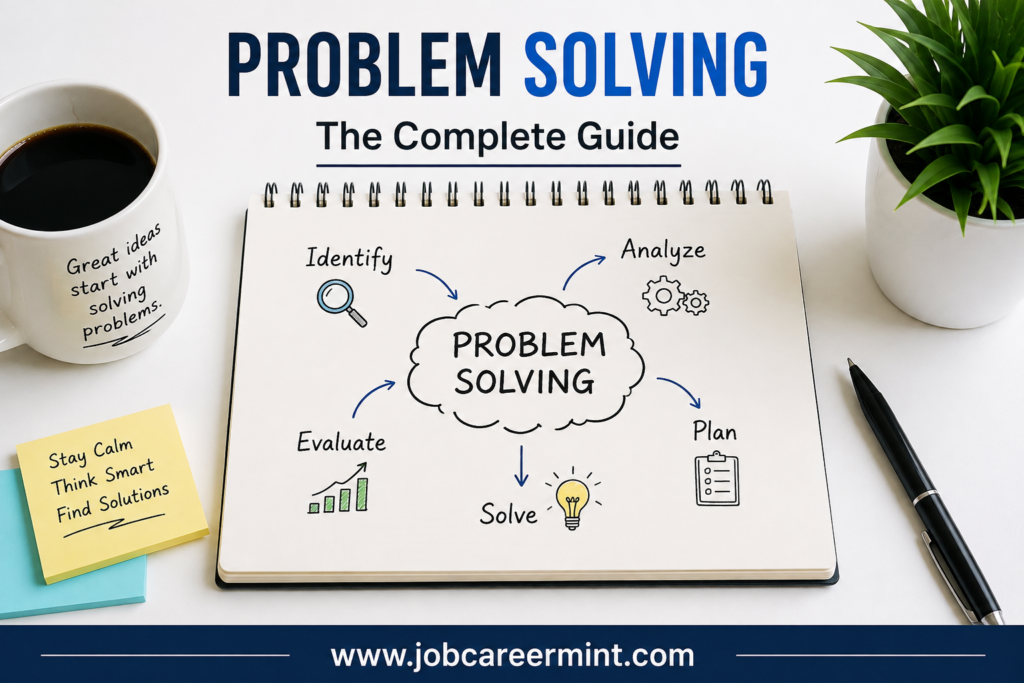
Problem-Solving Skills refer to your ability to identify a challenge, understand its root cause, evaluate possible solutions, and choose the most effective action. Instead of reacting emotionally, skilled problem solvers use logic, creativity, and critical thinking to reach better outcomes.
These skills are useful in almost every situation—whether you’re preparing for a job interview, managing a business, handling workplace challenges, improving relationships, or making important financial decisions.
Why Are Problem-Solving Skills Important?
Every day, people make hundreds of decisions. Some are simple, while others can significantly impact careers, businesses, education, and personal growth. Strong Problem-Solving Skills help you make informed decisions instead of impulsive ones.
Organizations value employees who can solve problems independently because they save time, improve efficiency, reduce costs, and contribute to better teamwork.
- Improves decision-making ability.
- Increases workplace productivity.
- Builds confidence in challenging situations.
- Enhances leadership potential.
- Strengthens analytical thinking.
- Helps manage stress effectively.
- Supports career growth and promotions.
- Encourages innovation and creativity.
Common Types of Problems You May Face
Understanding the nature of a problem is the first step toward solving it effectively. Different situations require different approaches.
- Workplace Challenges
- Career Decision Problems
- Business and Financial Issues
- Academic Difficulties
- Technical Problems
- Communication Barriers
- Time Management Issues
- Personal Life Challenges
- Team Conflicts
- Customer Service Problems
Each type of problem requires careful observation, logical analysis, and the willingness to explore multiple solutions before making a final decision.
The 7-Step Problem-Solving Process
People often make the mistake of searching for a solution before fully understanding the problem. However, effective Problem-Solving Skills follow a structured process that helps identify the real issue and find practical solutions.
Whether you’re solving a workplace challenge, business issue, academic difficulty, or personal problem, following these steps can improve your decision-making and reduce unnecessary mistakes.
- Identify the actual problem.
- Understand the root cause.
- Collect relevant information.
- Generate multiple possible solutions.
- Evaluate the advantages and disadvantages.
- Choose the best solution.
- Review the results and make improvements if needed.
How to Identify the Root Cause of a Problem
Many people solve only the visible symptoms instead of addressing the actual cause. As a result, the same problem keeps returning. Strong Problem-Solving Skills require you to investigate why the issue happened in the first place.
Ask yourself questions such as:
- What exactly happened?
- When did the problem start?
- Who or what is affected?
- Why did it happen?
- What factors contributed to it?
- Has this happened before?
Answering these questions helps you understand the complete situation before taking action.
Critical Thinking: The Secret Behind Smart Decisions
Critical thinking is one of the most valuable components of Problem-Solving Skills. Instead of accepting information at face value, critical thinkers evaluate facts, question assumptions, and consider different perspectives before reaching a conclusion.
People with strong critical thinking abilities are generally better at handling uncertainty, making informed decisions, and avoiding costly mistakes.
- Analyze facts instead of assumptions.
- Separate opinions from evidence.
- Consider multiple viewpoints.
- Stay objective during difficult situations.
- Focus on long-term results instead of short-term convenience.
Creative Thinking vs Logical Thinking
Excellent Problem-Solving Skills require both creativity and logic. Creative thinking helps generate new ideas, while logical thinking helps evaluate which idea is practical and effective.
Using both approaches together allows you to discover innovative yet realistic solutions for complex challenges.
10 Proven Ways to Improve Your Problem-Solving Skills
Like any other professional skill, Problem-Solving Skills can be developed through regular practice and the right mindset. People who consistently work on improving their thinking process become better decision-makers and perform more effectively in both personal and professional life.
- Practice solving real-life challenges instead of avoiding them.
- Read books that improve critical thinking and decision-making.
- Analyze successful people and their decision-making process.
- Break large problems into smaller, manageable parts.
- Stay calm during stressful situations.
- Improve communication and listening skills.
- Seek constructive feedback from mentors and colleagues.
- Learn from your previous mistakes instead of repeating them.
- Continue learning new skills and technologies.
- Never stop asking questions before making important decisions.
Common Problem-Solving Mistakes to Avoid
Even experienced professionals sometimes make mistakes while solving problems. Recognizing these common errors can help you make smarter decisions and avoid unnecessary setbacks.
- Making decisions without understanding the actual problem.
- Ignoring facts and relying only on assumptions.
- Choosing the fastest solution instead of the best one.
- Allowing emotions to control important decisions.
- Ignoring valuable feedback from others.
- Giving up too quickly after the first failure.
- Failing to evaluate the results after implementing a solution.
Problem-Solving Skills in Job Interviews
Recruiters often assess Problem-Solving Skills through situational and behavioral interview questions. Instead of looking for perfect answers, they want to understand your thinking process, decision-making ability, and approach to handling challenges.
When answering interview questions, explain the situation, describe the challenge, outline the steps you took, and highlight the final result. This demonstrates structured thinking and professional maturity.
Final Thoughts
Developing strong Problem-Solving Skills is one of the smartest investments you can make for your future. These skills help you overcome challenges, make confident decisions, improve workplace performance, and become a valuable asset to any organization.
Remember that effective problem-solving is not about finding quick answers—it’s about understanding the situation, thinking critically, exploring multiple solutions, and making informed decisions. With consistent practice, patience, and continuous learning, anyone can become a better problem solver.
Frequently Asked Questions (FAQs)
What are problem-solving skills?
Problem-solving skills are the ability to identify a problem, analyze its root cause, evaluate possible solutions, and choose the most effective course of action.
Why are problem-solving skills important?
They help improve decision-making, increase productivity, reduce stress, strengthen leadership abilities, and enhance career growth opportunities.
Can problem-solving skills be improved?
Yes. Regular practice, critical thinking, continuous learning, and solving real-world challenges can significantly improve your problem-solving abilities over time.
Do employers value problem-solving skills?
Absolutely. Employers across industries consider problem-solving one of the most valuable soft skills because it helps employees handle challenges efficiently and contribute to organizational success.

Hi, I’m Adi Malik, the founder of JobCareerMint. I share the latest government and private job updates, career guidance, resume tips, interview preparation, and skill development content to help students, freshers, and job seekers build successful careers. My goal is to provide accurate, easy-to-understand, and valuable information that helps people find better career opportunities.