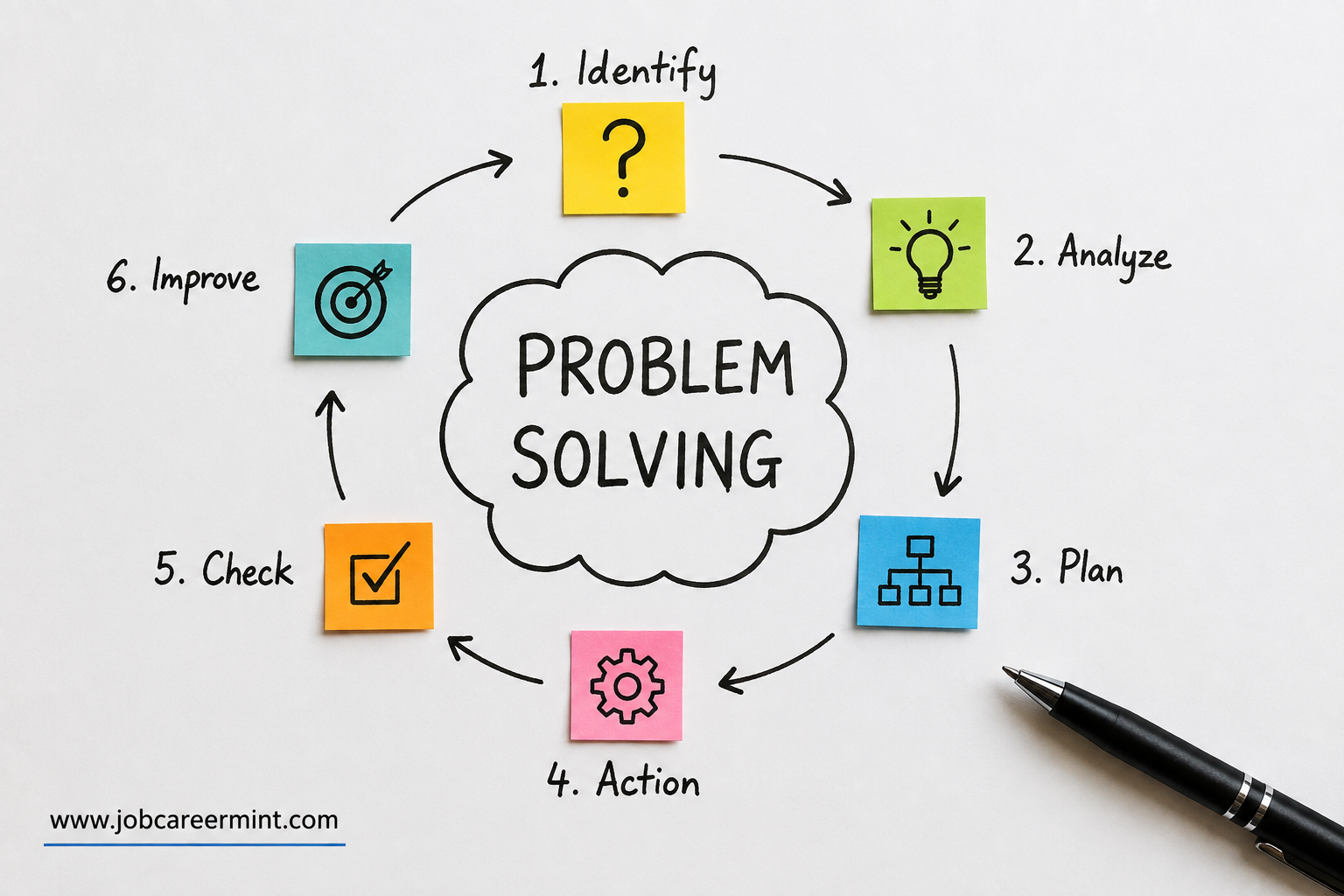
How to Solve Problems When You Don’t Know Where to Start: A Practical Step-by-Step Guide
Sometimes the hardest part of solving a problem is not finding the answer. It is figuring out where to begin.
You may know that something is wrong, but the situation feels too complicated to understand. There may be too many possibilities, too much information or several issues happening at the same time. In such situations, trying random solutions can make things even more confusing.
The good news is that you do not need to understand everything at once. A better approach is to break the situation into smaller parts, identify what you know, find what you do not know and then work toward the most likely cause.
This guide explains a simple problem-solving framework that can be used for work, studies, career decisions, technology, business and everyday situations.
Why Do We Get Stuck on Problems?
People often assume that difficult problems require exceptional intelligence. In reality, many problems become difficult because they are poorly defined.
For example, saying:
“My career is not going well.”
does not give you enough information to determine what needs to change.
But if you break it down, you may discover something more specific:
- I am not getting enough interview calls.
- My resume does not match the jobs I want.
- I have the qualification but lack a particular skill.
- I am applying to jobs that do not match my experience.
- I am getting interviews but struggling to convert them into offers.
Now the problem is much easier to investigate.
A vague problem creates vague solutions. A clearly defined problem gives you something specific to work on.
Step 1: Stop and Describe What Is Actually Wrong
When something goes wrong, the first instinct is usually to fix it immediately. Resist that urge for a moment.
Instead, write down what you can actually observe.
Ask:
- What happened?
- What should have happened?
- What is different?
- When did the difference begin?
- How often does it happen?
- Who or what is affected?
Try to describe the problem without explaining its cause yet.
For example:
“My website is performing badly.”Better description:
“Organic clicks have decreased compared with the previous period, while the number of published pages has remained similar.”
The second description gives you something measurable to investigate.
Step 2: Separate Facts, Assumptions and Questions
This is one of the most useful techniques when you feel confused.
Create three simple lists:
| Category | Meaning | Example |
|---|---|---|
| Facts | Things you can verify. | Applications decreased this month. |
| Assumptions | Things you believe may be true but haven’t confirmed. | Maybe the new design caused the decline. |
| Questions | Things you need to discover. | Did the decline begin immediately after the change? |
This simple separation prevents assumptions from quietly becoming “facts” in your mind.
Step 3: Break the Big Problem Into Smaller Problems
A large problem can feel impossible because it contains several smaller problems hidden inside it.
Imagine someone says:
“I can’t find a job.”
Instead of treating this as one giant problem, divide it into stages:
Job Search
↓
Am I finding suitable vacancies?
↓
Am I meeting the eligibility requirements?
↓
Is my resume relevant?
↓
Am I getting interview calls?
↓
Am I performing well in interviews?
↓
Am I converting interviews into offers?
Now the person can identify exactly where the process is failing.
If applications are being submitted but there are no interview calls, the solution may be completely different from a situation where interviews are happening but offers are not.
Step 4: Find the First Point Where Things Went Wrong
When a process contains multiple stages, find the first stage that stopped working correctly.
This technique is useful because later problems are often consequences of an earlier issue.
For example:
| Stage | Status |
|---|---|
| Finding suitable jobs | Working |
| Submitting applications | Working |
| Receiving interview calls | Not working |
| Interview performance | Unknown |
| Offer conversion | Unknown |
There is no reason to spend most of your effort preparing for interviews if you are not reaching the interview stage in the first place.
Step 5: Ask “What Changed?”
When something that previously worked suddenly stops working, one of the strongest questions you can ask is:
The change could involve:
- A new process
- A new tool or software
- A different person or team
- A change in workload
- A change in timing
- A new requirement
- A change in environment
- A change in customer behaviour
- A change in your own routine
This does not mean the latest change is automatically the cause. It simply gives you a useful starting point for investigation.
Step 6: Don’t Solve Everything at Once
One of the biggest mistakes people make is trying to change ten things simultaneously.
Suppose your productivity has dropped. You decide to:
- Change your schedule.
- Install a new productivity app.
- Stop using social media.
- Change your workspace.
- Start waking up earlier.
- Change your diet.
- Start exercising.
If productivity improves, you may not know which change actually helped.
A better approach is to identify the most likely high-impact factor and test a practical change first.
A Simple Framework to Remember
STOP: Avoid reacting emotionally or randomly.
DEFINE: Describe exactly what is wrong.
BREAK DOWN: Divide the problem into smaller parts.
INVESTIGATE: Separate facts from assumptions and find evidence.
PRIORITIZE: Identify the part that matters most.
ACT: Try the most practical solution.
CHECK: Measure the result and decide what to do next.
Step 7: Identify What You Can Control
When a problem feels overwhelming, one useful technique is to separate the situation into three groups: what you can control, what you can influence, and what you cannot control.
| Category | Meaning | Example |
|---|---|---|
| Control | You can directly change it. | Your preparation, application quality or work process. |
| Influence | You can affect it but cannot guarantee the outcome. | A customer’s decision or an interviewer’s response. |
| Outside Your Control | You cannot directly change it. | Past events or decisions made by other people. |
Spend most of your problem-solving energy on the first category and use the second category strategically. Spending too much time worrying about the third category usually does not produce a solution.
Step 8: Prioritize the Problem Before Solving It
Not every part of a problem deserves the same amount of attention. When several issues appear at once, prioritize them based on impact, urgency and effort.
| Priority | Impact | What to Do |
|---|---|---|
| High | Major impact or urgent | Investigate and address first. |
| Medium | Important but manageable | Schedule a solution. |
| Low | Limited impact | Handle later if necessary. |
A common mistake is spending hours fixing small issues while the main problem remains untouched.
Step 9: Look for Patterns Instead of Isolated Events
One incident can be random. A repeated pattern usually gives you more useful information.
If a problem happens repeatedly, record when it happens and look for similarities.
- Does it happen at a particular time?
- Does it happen with a particular task?
- Does it happen after a specific change?
- Does it happen with certain people or conditions?
- Does it happen only when workload increases?
- Does it disappear when one factor changes?
For example, if a technical issue appears once, it may be difficult to identify its cause. If it appears every time a particular process is followed, that pattern provides a much stronger starting point.
Step 10: Use the “Smallest Useful Test”
When you have several possible explanations, you do not always need to investigate all of them at once. Find the smallest practical test that can eliminate one or more possibilities.
Imagine a device stops working. Instead of immediately replacing every component, you could first check:
- Is it receiving power?
- Is the connection secure?
- Does another compatible power source work?
- Does the problem occur with another cable or component?
Each simple test gives you new information and narrows the possibilities.
Step 11: Compare Solutions Before Choosing One
Once you understand the likely cause, list the practical solutions and compare them instead of choosing emotionally.
Consider these five factors:
- Impact: How much can this solution improve the situation?
- Effort: How much work is required?
- Cost: What resources will it require?
- Risk: What could go wrong?
- Reversibility: Can you easily undo the decision if it does not work?
| Solution | Impact | Effort | Risk |
|---|---|---|---|
| A | High | Low | Low |
| B | Very High | High | Medium |
| C | Medium | Very Low | Low |
In many everyday situations, a low-risk solution with meaningful impact is a good first option. More complex solutions can be considered if the initial approach does not work.
When You Have No Good Solution
Sometimes none of the available options looks perfect. This does not necessarily mean that you cannot move forward.
Instead, ask:
- Which option creates the least serious downside?
- Which option gives me more information?
- Which option is easiest to reverse?
- Can I test the solution on a smaller scale first?
- What is the cost of doing nothing?
The last question is especially important. People sometimes avoid making a decision because every option has a disadvantage, while forgetting that doing nothing is also a decision and can have consequences.
Use a Decision Tree When the Situation Is Confusing
A simple decision tree can turn a complicated situation into a series of smaller yes-or-no questions.
Is the problem happening right now?
↓ YES → Can you reproduce it?
↓ YES → What changed before it appeared?
↓ → Can the suspected cause be tested safely?
↓ YES → Run the smallest useful test.
↓ → Did the result support the hypothesis?
↓ YES → Test the appropriate solution.
↓ NO → Return to the possible causes and investigate another branch.
The purpose of a decision tree is not to make every problem mechanical. It simply prevents you from jumping randomly between unrelated solutions.
Example: Solving an Everyday Problem
Suppose you repeatedly arrive late to work or an appointment.
The obvious solution might be to “leave earlier.” But first, investigate the process.
| Question | Possible Finding |
|---|---|
| When does the delay begin? | Getting ready takes longer than expected. |
| Why? | Important items are not prepared beforehand. |
| What else causes delay? | Travel time is being underestimated. |
| What can be changed? | Prepare essentials earlier and use realistic travel time. |
| How will success be measured? | Arrival time over the next several days. |
The important lesson is that the solution came from understanding the process rather than simply reacting to the final symptom.
What to Do When You Feel Overwhelmed
When there are too many problems at the same time, trying to solve all of them mentally can make the situation feel even bigger.
Instead, take a sheet of paper or open a notes app and write down everything that needs attention.
Then divide the list into:
- Urgent: Needs immediate attention.
- Important: Has a meaningful long-term impact.
- Waiting: Depends on someone or something else.
- Optional: Useful but not essential right now.
Choose one important item and define its next action.
Don’t write: “Fix my career.”
Write: “Review the last five job applications and identify why they may not match the roles I selected.”
The second task is smaller, measurable and actionable. Once completed, it gives you information for the next step.
The “Next Step” Technique
If a problem still feels too large, ask one simple question:
Not the final solution. Not the complete plan. Just the next useful action.
For example:
- Need a better job? → Identify three suitable roles.
- Struggling with a subject? → Identify the exact chapter causing difficulty.
- Business sales are falling? → Compare recent sales with the previous period.
- A process keeps failing? → Identify the first stage where it breaks.
- A decision feels confusing? → Write down the three realistic options.
Once the next action is completed, you will usually have more information than you had before. That information makes the next decision easier.
Advanced Techniques for Solving Difficult Problems
Simple problems can often be solved by identifying the cause and taking action. More complicated situations require a deeper approach. When the problem has several possible causes, affects multiple people or keeps returning, a few structured techniques can make the investigation much easier.
1. The 5 Whys Technique
The 5 Whys technique is a simple way to move from a visible problem toward a possible root cause. You repeatedly ask “Why?” until you reach an underlying reason that can actually be addressed.
Example: A team keeps missing deadlines.
Why? Some tasks are completed late.
Why? Employees underestimate how long the tasks will take.
Why? Previous project data is not being used when planning new work.
Why? There is no standard estimation process.
Possible root cause: The planning process does not have a consistent method for estimating task duration.
The purpose is not to ask exactly five questions every time. Sometimes three questions are enough; sometimes more investigation is necessary.
2. Fishbone Analysis
When a problem has many possible causes, a Fishbone Diagram, also called an Ishikawa diagram, can help organize them.
Instead of investigating random possibilities, group potential causes into areas such as:
- People: Skills, communication or training.
- Process: Procedures, workflow or planning.
- Technology: Software, hardware or systems.
- Environment: Workplace or external conditions.
- Resources: Time, materials or information.
- Measurement: Incorrect or missing data.
This approach is particularly useful when several factors may be contributing to the same problem.
3. Pareto Thinking
Sometimes a problem has dozens of possible causes, but only a small number of them create most of the impact.
This is where Pareto thinking can help. Instead of treating every issue equally, identify the causes that appear most frequently or create the greatest damage.
For example, if a customer-support team receives 1,000 complaints, analyzing every complaint individually may be inefficient. Grouping them could reveal that a few recurring issues account for a large portion of the complaints.
4. Reverse the Problem
If you cannot figure out how to achieve the desired result, try asking the opposite question.
Instead of asking:
“How can I make this process successful?”
Ask:
“What would guarantee that this process fails?”
Then list the actions that would cause failure and make sure you are not doing them.
This technique can expose risks that are difficult to notice when you focus only on the desired outcome.
5. Work Backward From the Desired Result
Sometimes starting from the beginning is confusing. Working backward can make the path clearer.
For example, suppose your goal is to successfully complete a job application.
Desired Result
↓
Application successfully submitted
↓
Required information completed
↓
Documents prepared
↓
Eligibility confirmed
↓
Suitable vacancy identified
Working backward helps reveal what must be completed before the final result can happen.
How to Solve a Problem With Incomplete Information
Many real-world problems cannot be solved with perfect information. Waiting until you know everything may cause unnecessary delays.
Instead, separate the information into three groups:
- Known: Information you can verify.
- Unknown: Information you do not currently have.
- Assumed: Information you believe may be true but have not verified.
Then identify which unknown information could actually change your decision.
Not every missing detail is equally important.
How to Avoid Analysis Paralysis
Research is useful, but too much research can become another problem. Analysis paralysis happens when someone keeps collecting information and comparing options without taking action.
To avoid it:
- Define what information is actually needed.
- Set a reasonable research limit.
- Separate important information from interesting information.
- Choose a decision deadline when appropriate.
- Prefer a small reversible test when possible.
- Accept that some decisions involve uncertainty.
The objective is not to achieve 100% certainty. The objective is to make a sufficiently informed decision with the information available.
What If Your First Solution Fails?
A failed solution does not automatically mean that you failed at problem solving.
Sometimes the first solution provides useful information about what does not work.
After a solution fails, ask:
- Did we correctly identify the problem?
- Was our assumed cause actually correct?
- Was the solution implemented as planned?
- Did another factor interfere with the result?
- Did we measure the right outcome?
- What did we learn from the attempt?
How to Solve Problems Under Pressure
Pressure can make even simple problems feel complicated. When time is limited, use a shorter version of the problem-solving framework.
- Define the immediate problem.
- Identify the biggest risk.
- Find the information that matters most.
- Choose the safest practical action.
- Check the result.
- Improve the solution when the immediate situation is stable.
During an emergency or high-risk situation, safety should take priority over experimentation. In technical, medical, financial or legal matters, professional guidance may also be necessary.
Problem-Solving Skills You Can Develop
Problem solving is not a fixed personality trait. It can improve through practice.
| Skill | How to Practice |
|---|---|
| Critical Thinking | Question assumptions and look for evidence. |
| Decision Making | Compare options using clear criteria. |
| Observation | Notice patterns, changes and unusual results. |
| Creativity | Generate multiple solutions before choosing one. |
| Communication | Explain problems and solutions clearly to others. |
| Adaptability | Change your approach when evidence shows that it isn’t working. |
A 10-Minute Problem-Solving Exercise
You can practice the skill without waiting for a major problem.
Choose one small issue you currently want to improve and answer these questions:
1. What exactly is happening?
2. What should be happening instead?
3. What facts do I know?
4. What am I assuming?
5. What are the three most likely causes?
6. Which cause can I test first?
7. What is the smallest useful action?
8. What result will tell me whether it worked?
Doing this regularly trains you to approach problems systematically instead of reacting automatically.
Problem Solving vs Quick Fixes
| Quick Fix | Problem Solving |
|---|---|
| Focuses on the immediate symptom. | Looks for the underlying cause. |
| Often relies on assumptions. | Uses evidence where possible. |
| May solve the issue temporarily. | Attempts to reduce recurrence. |
| Often starts with one solution. | Compares multiple options. |
| May not measure the result. | Checks whether the solution worked. |
How to Become a Better Problem Solver
Good problem solving is not about having an answer for every situation. It is about developing a reliable way of thinking when the answer is not obvious.
You can improve this skill by making a few habits part of your everyday routine:
- Pause before reacting to a difficult situation.
- Define the actual problem instead of describing only the symptoms.
- Ask better questions before searching for answers.
- Separate facts from assumptions.
- Look for patterns and changes.
- Break large problems into smaller pieces.
- Consider more than one possible solution.
- Start with a small, low-risk action when possible.
- Measure the result instead of assuming that something worked.
- Learn from unsuccessful attempts.
Over time, this process becomes almost automatic. Instead of immediately thinking “This is too complicated,” you begin thinking “What do I know, what don’t I know, and what should I check first?”
Problem-Solving Template You Can Save
Whenever you face a difficult situation, use the following template:
1. The Problem
What exactly is happening?
2. Desired Result
What should happen instead?
3. Facts
What information can I verify?
4. Assumptions
What am I currently assuming?
5. Possible Causes
What could be causing this?
6. Priority
Which cause or part of the problem matters most?
7. Options
What are the realistic solutions?
8. First Action
What is the smallest useful step I can take?
9. Result
What happened after the action?
10. Next Step
What did I learn and what should I do next?
Real-Life Situations Where This Framework Helps
The same framework can be adapted to many different situations.
| Situation | First Question to Ask |
|---|---|
| Job Search | At which stage are applications getting stuck? |
| Studies | Which exact topic or stage is causing difficulty? |
| Work | Where does the workflow first slow down? |
| Business | What changed in the numbers or process? |
| Technology | Can the problem be reproduced consistently? |
| Daily Planning | Which task has the greatest impact if completed first? |
Frequently Asked Questions About Problem Solving
What is the first step in problem solving?
The first step is to define the problem clearly. Before looking for a solution, describe what is actually happening, what should be happening and what has changed.
What should I do when I don’t know how to solve a problem?
Do not try to solve the entire problem immediately. Break it into smaller parts, separate facts from assumptions and identify the next useful question or action.
Why is identifying the root cause important?
Because fixing only the visible symptom may provide temporary relief while the underlying issue remains. Finding the root cause increases the chance of preventing the same problem from returning.
Is problem solving a skill that can be learned?
Yes. Problem solving can be improved through practice. Critical thinking, observation, decision-making, questioning, analysis and communication all contribute to stronger problem-solving ability.
What is the 5 Whys technique?
The 5 Whys is a root-cause analysis technique in which you repeatedly ask why a problem occurred. The goal is to move beyond the immediate symptom and investigate the underlying cause.
What if there are several possible causes?
List the possible causes and prioritize them based on evidence, likelihood and potential impact. When possible, use a small test to eliminate unlikely explanations before making a major change.
How can I solve a problem quickly?
Start by defining the immediate issue, identifying the biggest risk, checking the most important information and taking the safest practical action. After the immediate situation is controlled, investigate the deeper cause.
Should I always choose the fastest solution?
No. The fastest solution is not necessarily the best solution. Consider impact, cost, effort, risk and whether the solution addresses the actual cause.
What should I do if my solution does not work?
Review the problem definition, assumptions, suspected cause and implementation. A failed attempt can provide useful information. Use what you learned to adjust the next approach rather than blindly repeating the same solution.
How can problem-solving skills help in a job?
They can help employees handle unexpected situations, troubleshoot issues, improve processes, communicate solutions and make better decisions. Problem solving is therefore useful across many different roles and industries.
Final Takeaway
You do not need to be naturally brilliant at solving problems. You need a process that helps you think clearly when the answer is not obvious.
When you feel stuck, remember:
Define the problem → Break it down → Check the facts → Find the cause → Compare options → Take the next useful step → Measure the result
The goal is not to eliminate every problem from your life. Problems will continue to appear at work, in studies, business and everyday situations.
The real advantage comes from becoming better at understanding problems, making decisions and learning from the results.
And when you genuinely don’t know where to start, don’t worry about finding the complete answer immediately.
Start by finding the next useful question.
Quick Reminder:
A difficult problem becomes easier when you stop treating it as one giant problem and start turning it into a series of smaller questions that can be answered one at a time.
Related Problem-Solving Guides
Readers who want practical solutions can also explore other guides in the Problem Solving category, including application issues, document-related problems and step-by-step troubleshooting guides.
Last Updated: August 2026

Hi, I’m Adi Malik, the founder of JobCareerMint. I share the latest government and private job updates, career guidance, resume tips, interview preparation, and skill development content to help students, freshers, and job seekers build successful careers. My goal is to provide accurate, easy-to-understand, and valuable information that helps people find better career opportunities.