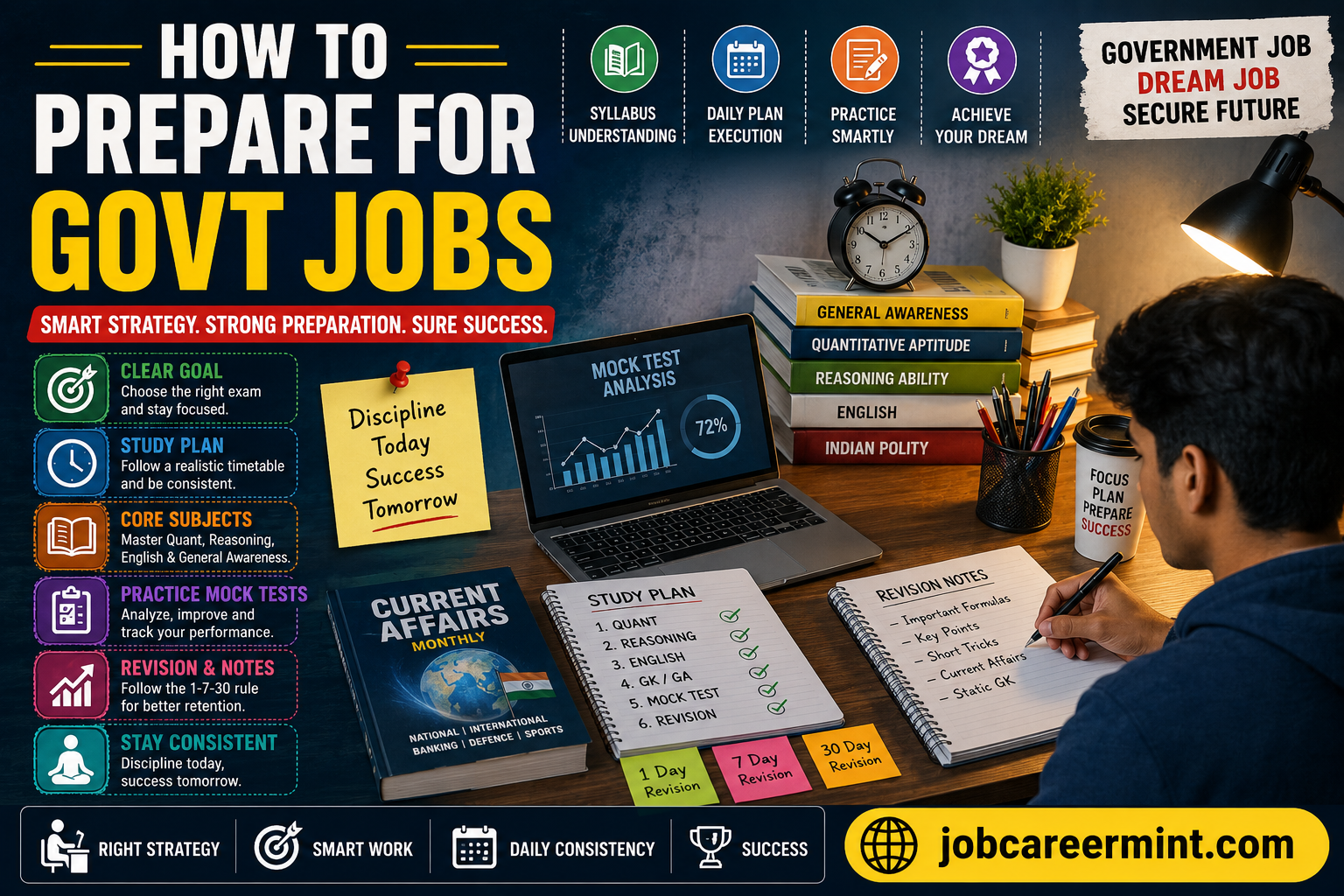
Let’s stop romanticizing the struggle for a second. If you clicked on this guide, you are probably trying to figure out exactly How To Prepare For Govt Jobs without wasting three to four years of your prime youth. Every year, millions of Indian students pack their bags, download endless syllabus PDFs, and buy heavy books hoping to secure a stable future. Yet, less than 1% actually make the final merit list.
The harsh reality? The students who fail aren’t necessarily weak in math or English. They fail because their strategy is completely broken. They spend twelve hours a day watching motivational YouTube shorts instead of actually solving math problems. They treat the exam like an emotional journey rather than a tactical military operation.
The competition in 2026 is absolutely ruthless. With AI-driven mock tests, smarter competitors, and unpredictable cutoff spikes, the old methods of rote learning are dead. This no-nonsense guide by Jobcareermint.com tears down the outdated advice and shows you exactly how to prepare for govt jobs today, build a bulletproof routine, and actually get your name on that final PDF.
The Deadliest Trap: Fighting on Every Front
This is the number one reason beginners burn out within six months. You cannot sit in the SSC CGL boat while keeping one foot in the UPSC ship and your hands tied to IBPS PO.
Every single examination board has a completely different DNA. Bank exams test your extreme speed and calculation pressure. UPSC tests your deep analytical endurance. SSC tests your repetitive accuracy and advanced math tricks. If you try to study for all three simultaneously, you will master none.
Pick your battlefield. Analyze your graduation background, your financial runway (how long you can survive without a salary), and your natural strengths. Commit to one primary exam category and ignore the rest.
Stop the “Telegram PDF Hoarding” Syndrome
We see this every single day. An aspirant joins forty different Telegram channels, downloads gigabytes of free current affairs magazines, topper notes, and shortcut trick sheets. They save them to a folder called “Preparation 2026” and never open them again.
Collecting material is not studying; it just gives you a fake dopamine hit of productivity.
The secret weapon of actual toppers is resource limitation. Pick one standard book for Quant. Pick one trusted teacher for Reasoning. Pick one monthly magazine for Current Affairs. Read that single book ten times rather than reading ten different books one time. Repetition builds muscle memory; hoarding just builds anxiety.
The Core Stack: Where You Actually Make Your Marks
If you want to know how to prepare for govt jobs effectively, you have to break down the syllabus into high-ROI (Return on Investment) sectors. Your fundamentals in the core subjects must become completely automatic.
Quantitative Aptitude: Stop running after magical 5-second tricks before you understand the basic concept. Master percentages, ratios, and basic arithmetic first. If your foundation is strong, the speed will naturally follow.
Logical Reasoning: This isn’t something you can just read. Reasoning requires pure, unadulterated practice. Do 50 questions a day. Make seating arrangements and syllogism your strongest weapons.
Current Affairs: Do not read a 20-page newspaper for three hours every morning. You are not writing a thesis. Use a reliable monthly compilation to cover government schemes, defense exercises, appointments, and sports. Keep it strictly exam-oriented.
Mock Tests: Your Reality Check
Reading theory feels safe. Taking a mock test hurts your ego. That is exactly why most students avoid mocks until the last month. And that is exactly why they fail.
You need to start giving full-length mock tests even when your syllabus is only 50% complete. The real magic doesn’t happen during the two hours you spend giving the test. It happens during the two hours you spend analyzing it afterward.
- Which math question consumed 4 minutes instead of 40 seconds?
- Which silly mistake cost you negative marks?
- Which topics are consistently dragging your score down?
Mocks teach you the art of skipping. Knowing which hard question to leave is just as important as knowing which easy question to solve.
The 1-7-30 Revision Rule
You study the Mughal Empire on Monday. By next Monday, you have forgotten who fought the First Battle of Panipat. This happens because human memory degrades rapidly without systematic reinforcement.
Implement the 1-7-30 cycle. Whatever you study today, you must revise it tomorrow (Day 1). You must quickly glance over it next week (Day 7). And you must give it a solid read next month (Day 30). Keep your handwritten notes extremely short—use bullet points, flowcharts, and keywords. If your notes look like a textbook, you are doing it wrong.
The 2026 Reality: You Need a Plan B
Let’s have a very uncomfortable conversation. The sheer volume of applicants compared to the number of vacancies means that even brilliant, hardworking students might face rejection. That is the statistical reality.
Do not put your entire life on hold for half a decade. Dedicate two or three solid, uninterrupted years to your preparation. But alongside it, build a secondary skill. Learn basic data analysis, digital marketing, or advanced Excel. Having a backup plan doesn’t mean you are preparing to fail; it means you are taking the mental pressure off your shoulders so you can actually perform better in the exam hall.
The No-Nonsense Daily Routine
Forget the 16-hour study myths. Your brain cannot process complex information for that long. Here is a realistic, sustainable schedule that prevents burnout:
| Time Block | The Focus Area |
|---|---|
| Morning (High Energy) | Heavy lifting. Solve 50 Quant questions and 50 Reasoning puzzles. Do the hard stuff while your brain is fresh. |
| Afternoon (Mid Energy) | Theory building. Read your GS (General Studies) or English grammar. Make short, crisp notes. |
| Evening (Active Recall) | Attempt one mock test or sectional quizzes. This builds your exam temperament. |
| Night (Wind Down) | Analyze the mock test you just took. Do a light reading of daily Current Affairs. Go to sleep. |
Rapid-Fire Truths for Govt Job Aspirants
Do I really need expensive coaching to clear these exams?
Absolutely not. Everything you need to know is available for free on YouTube or in standard textbooks. Coaching institutes provide structured discipline, but they do not provide a magic pill. Self-study, combined with rigorous mock tests, is how the majority of top rankers clear the cutoffs today.
How many hours a day is actually enough?
Stop tracking hours and start tracking targets. Sitting at a desk for 10 hours daydreaming yields zero results. Six to eight hours of intense, phone-switched-off, deep work is more than enough to crack any Grade-B or Grade-C exam within a year.
Which government exam is the “easiest” to crack?
None of them. The “lower level” exams often have much higher competition because the eligibility criteria are broader. Stop looking for an easy way out. Pick an exam that aligns with your graduation subjects and commit to the grind.
Your Next Move
You now know how to prepare for govt jobs without falling into the classic traps. The roadmap is simple, but executing it daily when you don’t feel like it is the hard part. Close YouTube, delete the extra Telegram groups, pick up your core books, and get to work. Consistency is the only hack that actually exists.
For more unfiltered career strategies, exam blueprints, and job market realities, keep tracking the updates on Jobcareermint.com.

Adeeb Malik
Founder & Editor – JobCareerMint.com
Adeeb Malik is the Founder and Editor of JobCareerMint.com, a trusted online platform dedicated to providing accurate, timely, and easy-to-understand information related to Government Jobs, Private Jobs, Results, Admit Cards, Answer Keys, Government Schemes, Career Guidance, and Work From Home opportunities.
He focuses on researching official notifications, verifying information from trusted sources, and publishing content that helps students, job seekers, and professionals make informed career decisions. Every article is created with a strong commitment to accuracy, transparency, and user value.
Through JobCareerMint, Adeeb aims to simplify complex recruitment updates and career-related information by presenting them in a clear, reliable, and reader-friendly format. His mission is to build a trusted career resource that empowers millions of users across India.
Editorial Focus
Government Jobs • Private Jobs • Results • Admit Cards • Answer Keys • Government Schemes • Career Guidance • Work From Home