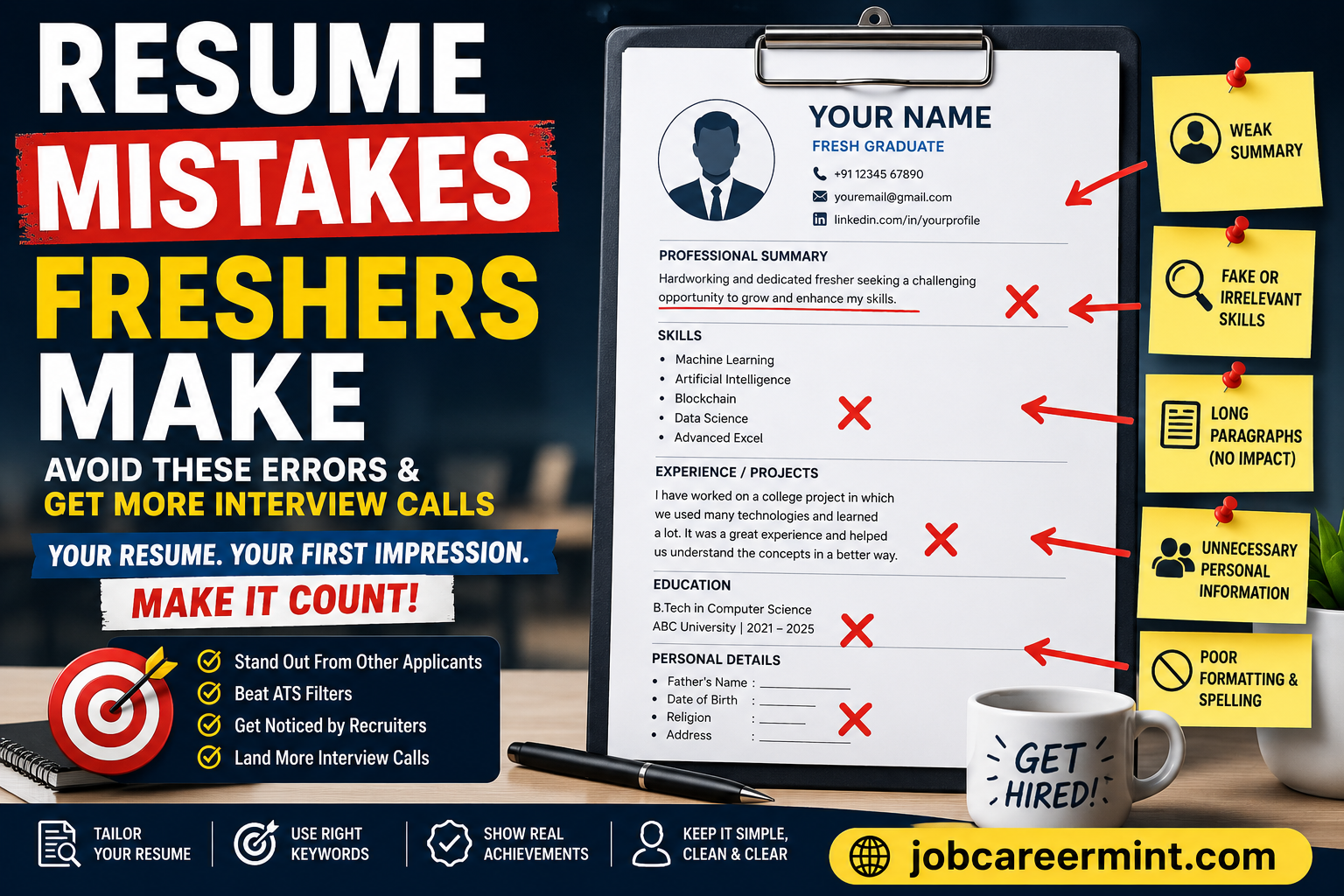
Resume Mistakes Freshers Make are silently destroying interview opportunities for thousands of graduates every single day. Let’s rip the band-aid off right now. You just spent three or four grueling years earning a degree, but a corporate recruiter is going to spend exactly six seconds deciding your fate. That is the unfiltered reality of the 2026 job market.
Thousands of fresh graduates are crying on LinkedIn about not getting interview calls, completely unaware that their resume is practically begging to be thrown into the rejection pile.
Hiring managers are not sipping coffee and reading your resume line-by-line. They are exhausted, staring at a screen with hundreds of applications for the exact same junior role.
Hiring managers are not sipping coffee and reading your resume line-by-line. They are exhausted, staring at a screen with 800 other applications for the exact same junior role. If your document is messy, generic, or packed with fake fluff, you are out before the game even begins.
Understanding the biggest resume mistakes freshers make is extremely important in 2026 because most companies now use ATS filters and AI-powered hiring systems before a recruiter even opens your application manually.
It is time to stop blaming the market and start fixing your pitch. This Jobcareermint.com breakdown exposes the exact resume blunders that are quietly destroying your career prospects—and how to fix them today.
1. The “Machine Gun” Application Strategy
This is the ultimate rookie mistake. You build one basic resume, save it as a PDF, and blast it to 200 different companies hoping someone bites. Recruiters can spot a mass-emailed resume from a mile away.
If you are applying for a digital marketing role using the exact same document you used to apply for a data entry gig, you are wasting everyone’s time. Every single job description asks for specific skills. If you don’t tailor your keywords and highlight the exact tools that specific company is asking for, you look lazy. Customize your pitch for the specific role, every single time.
2. The 1990s “Objective Statement”
If your resume opens with, “Hardworking fresher seeking a challenging environment to grow my skills and help the company succeed,” hit delete immediately.
Nobody cares about what you are seeking. A company is hiring you to solve their problems, not to fund your personal growth journey. Replace that outdated objective with a sharp, three-line Professional Summary. Tell them exactly who you are, what technical stack you know, and what tangible value you bring to the table right now.
3. Hallucinating Skills You Don’t Actually Have
Adding “Machine Learning” or “Advanced Excel” to your resume just because it looks cool on a Canva template is pure career suicide.
Faking your technical knowledge might get you past the initial screening, but the moment you sit down for a technical interview, you will be exposed in under two minutes. Once a hiring manager catches you lying about one skill, they assume your entire resume is fake. It is infinitely better to list three tools you can actually use blindly than ten tools you just Googled last night.
4. Getting Filtered by the ATS Bots
You might be furious that HR isn’t reading your application, but the truth is, a human probably never even saw it. Most modern companies use Applicant Tracking Systems (ATS) to filter out the noise.
If the job description explicitly asks for “Python,” “Tableau,” and “Data Visualization,” and your resume vaguely says “Database Management,” the AI filter will drop your file straight into the digital trash. You have to mirror the exact keywords from the job description into your experience section if you want to survive the bot scan.
5. Writing College Essays Instead of Bullet Points
Recruiters absolutely hate walls of text. Nobody is going to read a 400-word paragraph explaining the backstory of your final year college project.
Keep your formatting ruthless and scannable. Use sharp, single-line bullet points. Don’t just say what you did; state the problem, the tool you used, and the final outcome.
Stop writing this: “Worked on a major college project related to building a website where multiple coding languages were utilized by my team.”
Start writing this: “Developed a fully responsive e-commerce landing page using HTML, CSS, and JavaScript, reducing load time by 15%.”
6. Unprofessional Basics (Yes, people still do this)
It sounds ridiculous, but recruiters still toss out resumes because the contact info is a mess. If you are applying to a serious corporate job with an email like cool_dude_rahul99@yahoo.com, you are actively sabotaging yourself. Buy a clean, professional email address (firstname.lastname@gmail.com).
Also, drop the useless biodata. Modern tech and corporate companies do not need to know your father’s name, your blood type, your religion, or your exact home address. Keep it clean: Name, Phone, Email, LinkedIn URL, and Portfolio Link.
7. Telling Instead of Showing (Zero Proof of Work)
Saying you know how to write code, design graphics, or edit videos is incredibly weak. Anyone can type those words onto a page.
In 2026, degrees are losing their weight while proof of work is becoming the ultimate currency. If you claim you can code, link your GitHub. If you claim you are a designer, link your Behance or Dribbble. If you are a writer, link a live blog. Showing a recruiter a live, breathing project you built on your own time instantly puts you in the top 1% of applicants.
Your Next Move
Stop treating your resume like an autobiography. It is a marketing document, and you are the product. Strip out the fluff, kill the typos, optimize for the bots, and treat every application like a sniper shot instead of a machine gun spray. Do this, and your phone will actually start ringing.
For more unfiltered career blueprints, interview hacks, and modern job market realities that actually move the needle, keep your eyes on the updates at Jobcareermint.com.

Adeeb Malik
Founder & Editor – JobCareerMint.com
Adeeb Malik is the Founder and Editor of JobCareerMint.com, a trusted online platform dedicated to providing accurate, timely, and easy-to-understand information related to Government Jobs, Private Jobs, Results, Admit Cards, Answer Keys, Government Schemes, Career Guidance, and Work From Home opportunities.
He focuses on researching official notifications, verifying information from trusted sources, and publishing content that helps students, job seekers, and professionals make informed career decisions. Every article is created with a strong commitment to accuracy, transparency, and user value.
Through JobCareerMint, Adeeb aims to simplify complex recruitment updates and career-related information by presenting them in a clear, reliable, and reader-friendly format. His mission is to build a trusted career resource that empowers millions of users across India.
Editorial Focus
Government Jobs • Private Jobs • Results • Admit Cards • Answer Keys • Government Schemes • Career Guidance • Work From Home