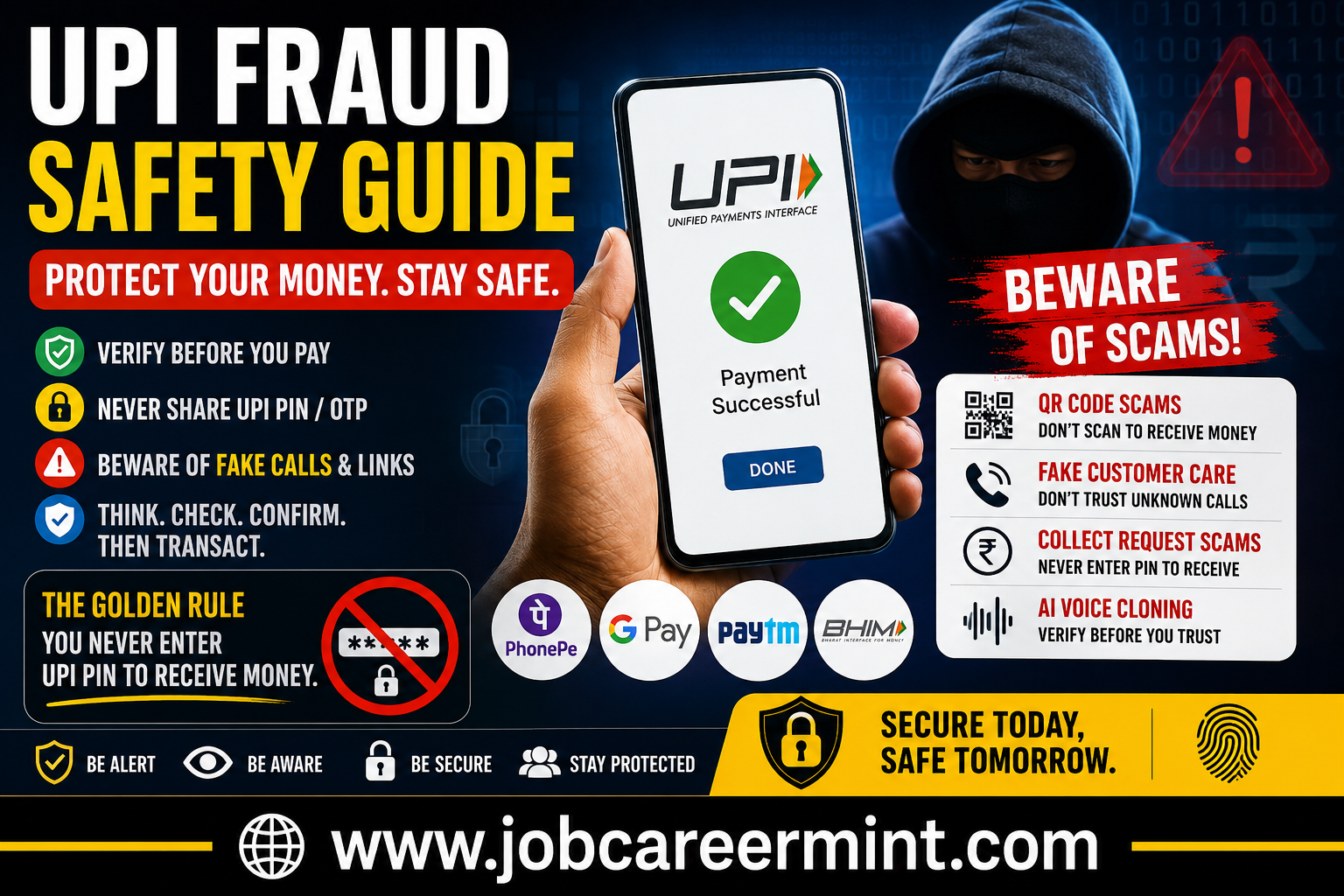
If you are looking for a practical, no-nonsense UPI Fraud Safety Guide to protect your hard-earned savings in 2026, you need to read this carefully. India is processing billions of digital transactions daily. While apps like PhonePe, GPay, and Paytm have made life incredibly effortless, they have also turned our smartphones into open ATM machines for cybercriminals.
Let’s be brutally honest right from the start. Hackers aren’t sitting in dark rooms breaking through heavy bank firewalls to steal your money. That only happens in movies. In reality, the technology behind the Unified Payments Interface is rock solid. The scams happen because fraudsters don’t hack systems—they hack human psychology.
They create panic, offer fake lottery greed, or confuse you just enough so that you voluntarily hand over your own money. This complete breakdown by Jobcareermint.com exposes the exact tactics scammers are using today and the ultimate rules you need to follow to lock down your bank account.
The Golden Rule of the UPI Fraud Safety Guide
If you memorize absolutely nothing else from this article, tattoo this single rule into your brain:
You NEVER, ever enter your UPI PIN to receive money.
Your UPI PIN acts exactly like your physical signature on a bank cheque. You only use it when money is leaving your account. If someone on the phone tells you to “Enter your PIN to claim a refund” or “Scan this code to receive your cash,” they are lying. The second you punch in those four or six digits, your bank balance drops.
The 4 Deadliest Scams Ruining Bank Accounts Today
Scammers evolve fast. Here are the specific traps actively destroying financial lives across India right now.
1. The OLX & Marketplace QR Trap
You list an old sofa or a bike online. Within ten minutes, a buyer calls. He agrees to your price without negotiating and says he will send an advance payment immediately. He sends a QR code on WhatsApp and tells you to scan it to receive the cash.
The Reality: Scanning a QR code only opens the “Pay” window. The moment you scan it and hit your PIN, you are sending him the money, not the other way around.
2. The Fake Google Customer Care Call
Your food delivery fails, or a payment gets stuck. You immediately go to Google and search “Zomato customer care number” or “PhonePe helpline.” You call the first number that pops up.
The Reality: Scammers manipulate Google search results. The guy answering the phone isn’t a bank executive. He will calmly ask you to download a “support app” like AnyDesk or QuickSupport. The second you install it, he can see your mobile screen live, read your OTPs, and empty your accounts while you are still on the phone with him.
3. The “Collect Request” Ambush
You get a notification on GPay saying “Cashback of ₹5,000 pending. Click to claim.” When you click it, the app asks for your UPI PIN.
The Reality: This is a “Collect Request.” The scammer has literally just sent you a bill. By entering your PIN, you are approving their request to pull funds directly out of your checking account.
4. The 2026 Threat: AI Voice Cloning
This is the scariest new trend. You get a panicked call from an unknown number. The voice sounds exactly like your brother or your father, claiming they are in a hospital or got arrested, begging you to transfer ₹20,000 immediately to a stranger’s number.
The Reality: Scammers are using AI tools to clone voices from social media videos. Always cut the call and dial your family member’s actual saved phone number to verify.
Your Personal Digital Armor: The Safety Checklist
To make this UPI Fraud Safety Guide actionable, we have condensed the survival tactics into a quick, readable matrix. Treat this as your daily digital checklist:
| The Action | The Brutal Truth |
|---|---|
| Remote Screen Apps | Never install AnyDesk or TeamViewer on a stranger’s request. No real bank will ever ask you to share your screen. |
| Reading the App Screen | Before hitting enter, look at the giant red/green buttons. Does it say “PAY” or does it say “REQUEST”? Read before you tap. |
| Unknown Links in SMS | “Your electricity connection will be cut tonight. Click here to pay.” It’s a classic phishing lie. Delete the message. |
| Fake APK Files | Stop downloading random apps from WhatsApp or Telegram. Stick to the official Google Play Store or Apple App Store. |
The Golden Window: What To Do If You Get Scammed
If you mess up and the money leaves your account, you do not have time to cry or feel embarrassed. You have a very tiny window to freeze the transaction before the scammer withdraws the cash from an ATM.
- Dial 1930 Immediately: This is the official National Cyber Crime helpline. Call them the exact second you realize you’ve been scammed.
- Lock the Portal: Go to cybercrime.gov.in and log a formal complaint so the authorities can instruct the receiving bank to freeze the account.
- Call Your Bank: Block your debit cards and temporarily disable UPI access from your banking app so they can’t hit you a second time.
Final Thoughts: Your Money, Your Responsibility
Every effective UPI Fraud Safety Guide comes down to a single core philosophy: Slow down. The internet is built for speed, but financial decisions should never be rushed. Scammers rely on creating a fake sense of urgency to make your brain skip logical thinking. When in doubt, pause, cut the call, and verify the facts.
For more raw, unfiltered financial defense strategies, career blueprints, and modern tech survival guides, keep tracking the updates on Jobcareermint.com.

Adeeb Malik
Founder & Editor – JobCareerMint.com
Adeeb Malik is the Founder and Editor of JobCareerMint.com, a trusted online platform dedicated to providing accurate, timely, and easy-to-understand information related to Government Jobs, Private Jobs, Results, Admit Cards, Answer Keys, Government Schemes, Career Guidance, and Work From Home opportunities.
He focuses on researching official notifications, verifying information from trusted sources, and publishing content that helps students, job seekers, and professionals make informed career decisions. Every article is created with a strong commitment to accuracy, transparency, and user value.
Through JobCareerMint, Adeeb aims to simplify complex recruitment updates and career-related information by presenting them in a clear, reliable, and reader-friendly format. His mission is to build a trusted career resource that empowers millions of users across India.
Editorial Focus
Government Jobs • Private Jobs • Results • Admit Cards • Answer Keys • Government Schemes • Career Guidance • Work From Home