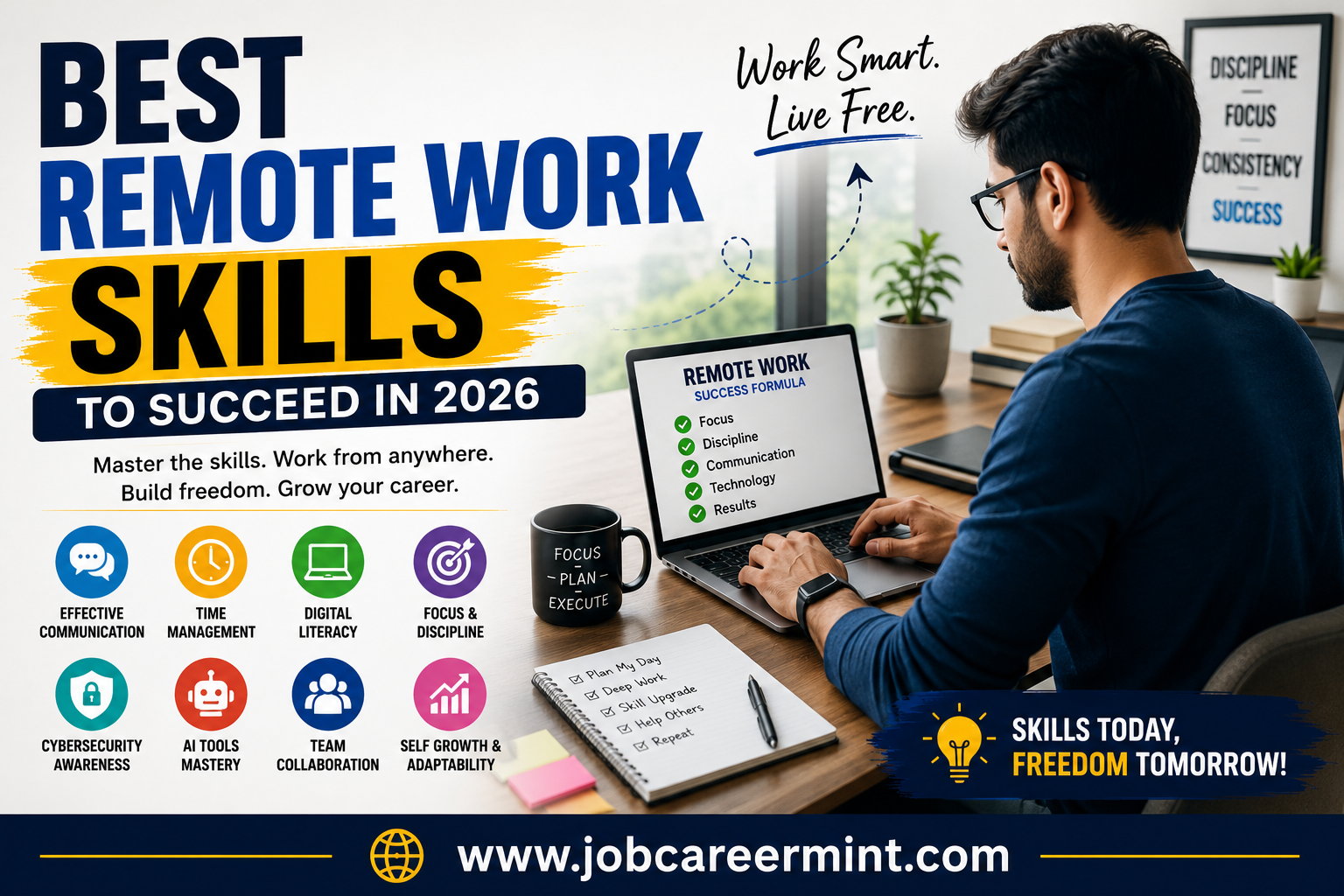
If you think working from home is just about answering emails from your bed while binge-watching Netflix, you are in for a massive reality check. Mastering the Best Remote Work Skills is no longer just a trendy option for digital nomads in 2026; it is a fundamental survival requirement. The remote job market has evolved into a hyper-competitive global arena where companies don’t care about your zip code—they only care if you can deliver actual results without a manager babysitting you.
We see people constantly complaining on LinkedIn about getting fired from remote roles or failing to clear virtual screening rounds. The hard truth? They lack the specific behavioral and technical muscles required to survive outside a traditional cubicle. The era of just “logging in” is over. You are now competing against top-tier talent from across the globe who are hungry, disciplined, and technologically lethal.
This raw breakdown by Jobcareermint.com strips away the fake Instagram aesthetics of working from a beach and exposes the exact, unfiltered skills you need to secure high-paying remote contracts and build long-term career freedom this year.
Why The Remote Game Changed Completely
Let’s look at the corporate math. Companies realized they can slash their office rent by 60% and tap into a global talent pool without paying premium Silicon Valley salaries. But the honeymoon phase of “work from anywhere” is officially over. Employers are actively weeding out average performers.
To keep your location independence and collect those heavy paychecks, you have to operate like a one-person business. Here is what actually keeps you hired.
1. Asynchronous Communication (The Ultimate Filter)
In a physical office, you can tap your colleague on the shoulder to ask a quick question. In a distributed team, that colleague might be sleeping in a completely different time zone. This is exactly why mastering written, asynchronous communication ranks at the absolute top of the best remote work skills you can develop.
You need to write Slack messages and emails that are so crystal clear that nobody has to schedule a 30-minute Zoom call just to decipher what you meant. Use bullet points. State the problem, provide the context, and offer a solution in one single message. If your communication is sloppy, you become a bottleneck. And remote bottlenecks get fired.
2. Deep Work & Distraction Warfare
Nobody is looking over your shoulder to see if you are scrolling through Instagram Reels or shopping on Amazon. Freedom is amazing, but it absolutely destroys undisciplined people.
The highest-paid remote workers don’t just “manage time”—they aggressively protect their focus. You need to know how to block out two hours of pure deep work, mute your Slack notifications, and actually produce output. If you let every WhatsApp ping break your concentration, you will end up working 12-hour days just to finish 4 hours of actual work.
3. Independent Troubleshooting (Stop Asking for Permission)
Managers despise remote employees who constantly ask, “What should I do next?” or “How do I fix this software bug?”
You have to become relentlessly resourceful. Before pinging your boss or flooding the team group chat, Google the error code, read the software documentation, watch a quick YouTube tutorial, and try to fix it yourself. When you do reach out, say: “This broke. I tried X and Y to fix it, but it didn’t work. Should I proceed with Z?” Ownership is the ultimate remote work currency.
4. AI Workflow Integration
You don’t need to be a machine learning engineer, but if you aren’t using AI to speed up your daily tasks, someone who does will eventually take your job.
You should actively be using ChatGPT to draft complex client emails, utilizing AI tools to summarize long virtual meetings, or running scripts to automate your data entry. Integrating artificial intelligence into your personal workflow cuts your operational time in half, making you look like an absolute productivity machine to your employer.
5. Navigating the Digital Ecosystem
Saying “I’m not very tech-savvy” is a completely unacceptable excuse in 2026. You are expected to seamlessly jump between different tech stacks without breaking a sweat.
If you struggle to manage permissions on a Google Doc, fumble while sharing your screen on Zoom, or don’t know how to integrate Trello with Slack, you immediately look unprofessional. Master the standard remote tech stack. It is the virtual equivalent of knowing how to use a pen and paper.
6. Cybersecurity Hygiene
When you work from a local café’s public Wi-Fi, you are a walking security risk. Companies are terrified of data breaches because one careless employee can cost them millions.
Understanding basic cybersecurity is no longer just an IT department requirement. You need to know how to operate a VPN, strictly use 2FA (Two-Factor Authentication), and spot sophisticated phishing emails instantly. If you treat company data carelessly, your remote privileges will be revoked permanently.
7. Building a “Proof of Work” Digital Footprint
How does a startup founder in London know you are a brilliant developer or marketer sitting in Delhi? They don’t look at your college degree; they look at your internet footprint.
Maintaining an active LinkedIn presence, a live digital portfolio, or a public GitHub repository is how you skip the crowded, desperate job portals. When you publicly document what you are building and learning, you attract inbound international opportunities directly to your inbox.
The Remote Survival Matrix
| The Skillset | Why You Actually Need It |
|---|---|
| Asynchronous Writing | Kills unnecessary meetings and keeps global teams moving without waiting for you to wake up. |
| Resourcefulness | Saves your manager’s time. You solve your own problems instead of acting like a helpless intern. |
| Focus Management | Prevents you from burning out. Keeps your actual work hours condensed and highly productive. |
| Digital Visibility | Ensures that your hard work is actually seen and valued by remote executives who never meet you in person. |
Final Thoughts: Own Your Environment
People think working from home means doing laundry while casually moving the mouse every ten minutes. The reality? True remote work demands much higher accountability, faster learning speeds, and better communication than a traditional office job ever did.
If you want to live life on your own terms, stop treating remote work like a vacation. Build the Best Remote Work Skills, protect your daily routine ruthlessly, and become so undeniably good that companies are forced to wire you money regardless of where you open your laptop.
For more unfiltered career truths, digital income strategies, and modern work survival blueprints, keep your eyes on the updates at Jobcareermint.com.
Related Career & Remote Work Guides

Adeeb Malik
Founder & Editor – JobCareerMint.com
Adeeb Malik is the Founder and Editor of JobCareerMint.com, a trusted online platform dedicated to providing accurate, timely, and easy-to-understand information related to Government Jobs, Private Jobs, Results, Admit Cards, Answer Keys, Government Schemes, Career Guidance, and Work From Home opportunities.
He focuses on researching official notifications, verifying information from trusted sources, and publishing content that helps students, job seekers, and professionals make informed career decisions. Every article is created with a strong commitment to accuracy, transparency, and user value.
Through JobCareerMint, Adeeb aims to simplify complex recruitment updates and career-related information by presenting them in a clear, reliable, and reader-friendly format. His mission is to build a trusted career resource that empowers millions of users across India.
Editorial Focus
Government Jobs • Private Jobs • Results • Admit Cards • Answer Keys • Government Schemes • Career Guidance • Work From Home